Hello, good evening and happy Sunday!
I’ve been working on this note for a few weeks now and every time I nearly finished it, I found another bit of interesting information to incorporate.
As a result, it’s another long piece but full of nuggets that I found cool throughout. There’s a series of (even longer) reports at the bottom too, should you want to read more.
As ever, I’d love any feedback and if you find it interesting, then please do send onto a friend as well.
Preamble
So I expect many of you will have seen or read the government’s recent advice to “Be Ready” for an emergency by having 3 days’ worth of supplies (and you can find out more here if you haven’t.)
Now the advice is largely event-agnostic, given how broad an emergency can be, but one event that I’ve been spending a lot of time thinking about recently is a National Power Outage, which is pretty high on the National Risk Register:
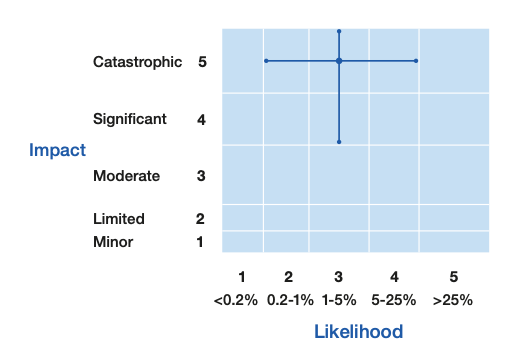
There has never been a total failure of the National Electricity Transmission System, and there’s only a remote chance of a total failure actually happening. Regional or more localised failures are more likely as 160,000 homes across the country will tell you after the first two storms of the season, and lessons from around the world show.
The most notable British example was in Lancaster in 2015, when a storm caused the River Lune to burst its banks. The ensuing flood submerged the city’s main electrical substation and cut power for 55,000 homes for nearly four days. I’ve put links at the end about what happened across Lancaster in the days that followed, for anyone interested, but the events of that week have informed some of the fictionalised account of a power cut that follows below.
But before we get into that, my friend Ellie is from Lancaster, and her family have very kindly shared some pictures from the outage. Now Ellie’s family are very outdoorsy, and they managed to get some lighting hooked up to their van and cook using camping equipment, as you can see in the pictures below.
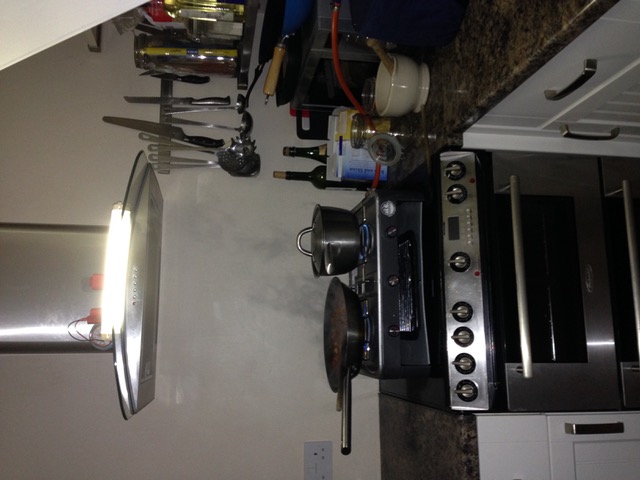
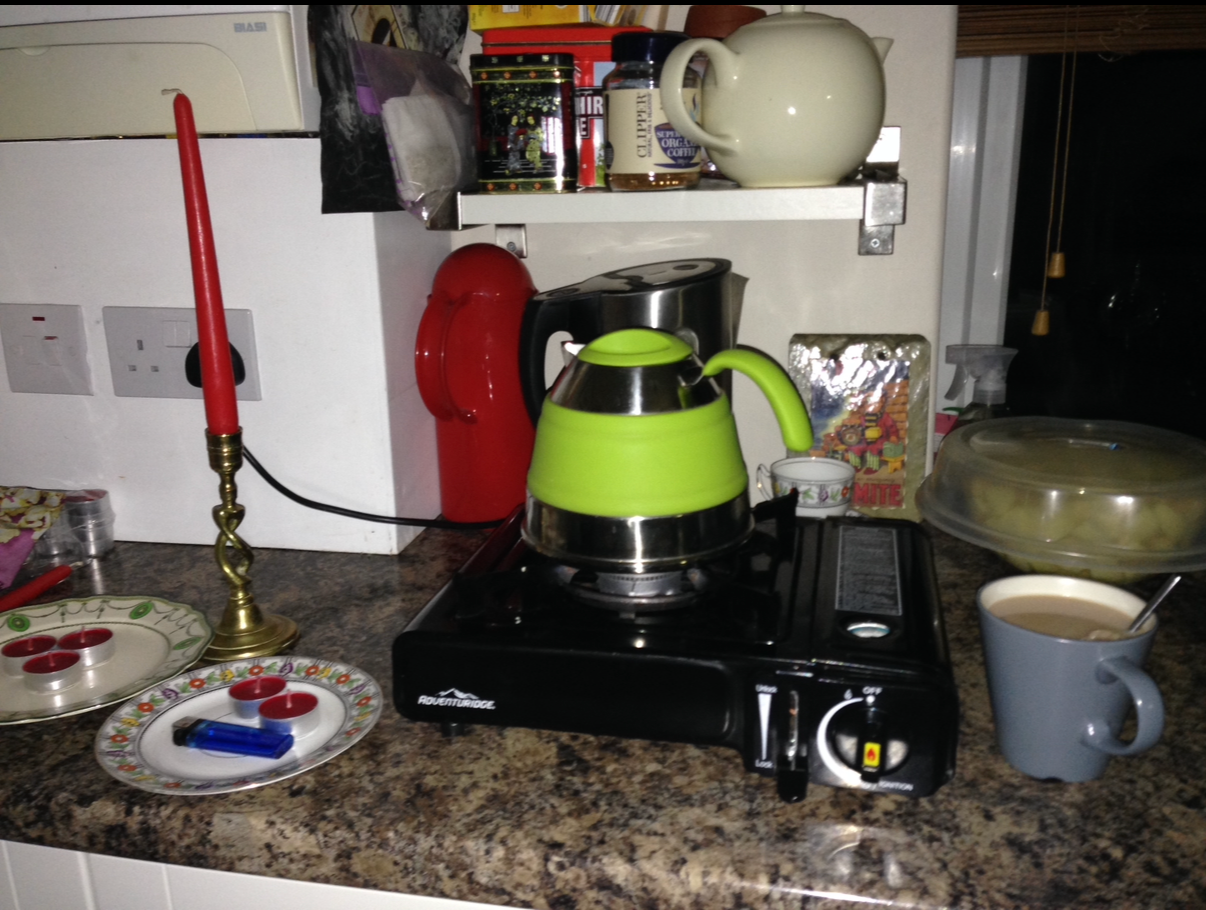
She says herself “I think we had an alright time because my parents are pretty handy people” and I’m told they were the only house with electrical lighting in the whole street. But I don’t think that’s particularly representative of most of the country.
Do you know what you’d do if the power went out? You’d probably be fine for a few hours, but what if it was out for a whole day? Or three? Or a week?
To provoke questions on just that, and in the spirit of Carlo Masala’s “If Russia Wins: A Scenario” and my own “November 2026: A Scenario” from earlier this year, the following is a fictionalised example of what life could look like if there was a National Power Outage across the UK. I’ve left little notes with numbers on them like this (1) throughout, which link to little explainers at the end that have a bit more context.
The Scenario
0400, Third Monday of January – Control Room of the National Energy System Operator (NESO) (1)
It’s just another Monday morning. There’s a faint smell of coffee and everyone is in a fairly good mood for Blue Monday. There’s a gentle buzz of chatter as the room prepares for the country to wake up. It’s been a cold winter and there’s a snowstorm inbound that they’re saying could be as bad as the Beast from the East in 2018.
The screen on the wall has a schematic of the UK’s power system (2). Everything’s ticking along normally. It’s just another week.
At the same time, unbeknownst to anyone in Britain or NESO, an army of smart internet devices are being powered up at the same time by a rogue AI agent. They all use a common piece of cloud infrastructure that the agent has found a software vulnerability in. And today, it’s going to use that vulnerability to turn Britain’s power off (3).
Smart fridges, doorbells, washing machines and televisions from across the country are set to turn on simultaneously in the dead of the night, when the system is expecting light demand. The sudden surge in demand causes the frequency of the power network to drop below 50Hz, and NESO emergency reserves to kick in to stabilise the frequency within 10 seconds.
In the NESO control room, there are no blaring alarms or flashing red lights. No one yells or runs around like a headless chicken. Instead, one light on the screen goes red. And then another. The buzz in the room turns into an eerie silence as everyone braces themselves for whatever comes next.
At first, the fail-safe system seems to have worked, but just as the frequency approaches 50Hz again, the army of smart devices across the country turn off again. Suddenly there’s an oversupply on the network, the frequency spikes and the system pivots. This oscillation happens a few times, and the magnitude of the frequency rises on each turning, until it approaches 48.8Hz (4).
This is when the system starts to shut itself down to protect itself. Power stations across the country start to load shed (i.e., cut the power supply to customers) to stop long-term damage. The NESO control room starts cutting off large industrials and factories, and for a moment it seems to have worked. The system seems to be stabilising.
But this was all expected. The hostile actor directing the AI agent knew this was how NESO would react and they came prepared. The parts of the country that haven’t had their power cut see a second wave of smart Internet of Things devices come online. The attack starts all over again and NESO is forced to continue load shedding by cutting the power to some residential homes.
Eventually, the load shedding isn’t enough to stabilise the frequency. It continues to drop and hits 47.5Hz, where generators across the country disconnect to protect themselves from damage. That means large providers of supply suddenly drop off the network, triggering a cascading effect that continues to drop the frequency on the network even further.
The NESO control room is silent.
Britain has never had a National Power Outage in the National Grid’s 75-year history.
Until now.
The NESO control room erupts into a hive of activity. Their emergency diesel generators have kicked in, and a message has gone across the HITS network to Whitehall (5). Their lights went out a few minutes ago and the civil servant on duty calls the Minister to wake her up. She wakes up the Prime Minister and they agree to convene COBRA and kick the power supply disruption framework into effect.
They’re about to have a very, very long day.
0700, Monday in January
Your alarm goes off. You snooze it and roll over to face the window, like you do every morning. Your curtains are drawn, but it’s darker than usual. There’s normally a bit of light from the streetlight getting through, but today it’s dark. Weird.
You check your phone and notice it’s only got 60% charge and there’s no WiFi. You unplug it and plug it back in and it still doesn’t charge. You try to check your messages and nothing is loading. You check your data, but there’s no service. (6) What’s going on with my phone?
You turn it off and on again and get up to go to the bathroom whilst it restarts.
You go to turn the bathroom light on and when it doesn’t, the penny drops. Oh, the power must be out.
There’s no window in your bathroom, so you prop the bathroom door open whilst you brush your teeth. It doesn’t help much.
You go to open your curtains to let some light in, but the sun doesn’t rise for another 50 minutes. For the first time, you look across the London skyline and see nothing. None of the lights in the high-rises are on. The usual glow from the city in the distance isn’t there. There’s no streetlights. It’s just dark out there, so eerily dark. The horizon is just starting to become visible, but that’s it. That’s scary.
You get in the shower, in the dark, and wait for the water to heat up. You’re waiting a while. The water doesn’t heat up. But I’ve got a gas boiler, surely that should keep working? (7)
You get out of the shower. Your feet are wet and cold and you’re not happy about it. Your phone has turned on again and still no WiFi or service. You try to Google why hot water goes in a power cut. It doesn’t load.
You get dressed, still a bit stinky, and go into the kitchen for some food.
You open the fridge and the light doesn’t turn on. The air still feels cool though, so you take some milk out and fill the kettle out of habit. You flick the switch and nothing happens. No power. You settle for a bowl of cereal.
It’s a Monday and you were planning on working from home, but since you’ve got no power here, you’re going to have to go in. There’ll be power in the office, and I can get a coffee on the way.
There’s a lot more people on the street than normal and you wonder how far out there’s no power. It looked like most of London in the morning, but surely it’ll be back on soon.
There’s a lot of traffic, mainly cars and a couple of buses. There are a lot of queues at the bus stops, more than usual. I hope the tube isn’t down…
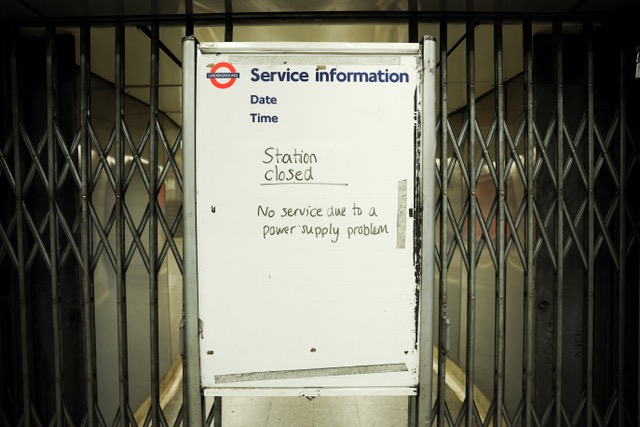
You get to your tube station. It’s still shuttered. Bus it is!
You try to check Teams on your phone and let your 9am meeting know you’ll be a bit late. Still no signal.
You’ve never got the bus to the office before, and you’re not entirely sure which one to get. You hop around a few bus stops and ask someone which one’s heading towards your office. You ask him if his power was out too, and he nods and puts his headphones back in. You get in the queue for the bus and put your headphones in too - thankfully some of your music is downloaded. It’s a long queue. I swear there’s normally more buses than this.(8)
The first bus comes and there’s no way you’re getting on. You’ve been waiting for 20 minutes at this point. It’s bloody cold and it’s starting to rain. Three more go by before you can squeeze onto one. You were starting to think this could be a little exciting, but you’re quickly dissuaded of that idea. A lot of people have chosen to walk, heading in towards the city. As the bus crosses the river, you hope that’ll be enough for your signal to tick back on. Still nothing.
The roads are chaos, and you notice there’s a lot of cars queuing up for petrol stations. They still don’t seem to have any power either. No one’s queuing for long enough to actually put petrol in though. (9)
You get off the bus. You’re near enough your office, but it’s still going to be a 10 minute walk. You’ve missed your 9am and it’s looking like you’re going to be late for your 10am too. Surely everyone is going to be late though - it’s a bit like a snow day.
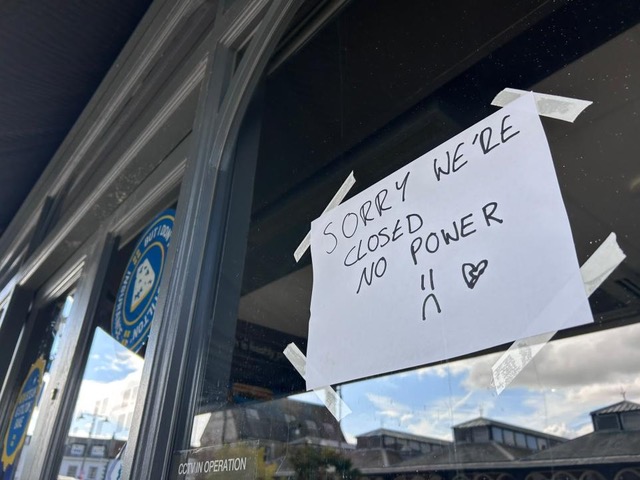
You walk past all the coffee shops and they’re all still closed. No lights and a few have signs up. No coffee after all…
You get to your office and there’s a small crowd outside. Someone says the emergency generator kicked in when the power went down. YES!! We have power!! I can’t wait to make a warm drink; it’s freezing.
But then the same person says the emergency generator only has enough power for emergency lighting and something they’re calling “critical functions”. Am I a critical function?
You are not a critical function. You can’t do any work without a charger and an internet connection. There is no WiFi and mobile networks are down. You are not doing any work today. I guess that paper can wait…
Someone tells you to go home. So this power cut is… everywhere? Now what?
You start to wander back towards the bus stop. The queue is even longer. A lot of people just seem to be walking, even though it’s cold and raining. Well, if there’s nothing else to do…
You start walking home. You see a queue waiting outside what looks like a coffee shop. They can’t get their coffee machine working, but are serving hot drinks out of a saucepan on what looks like a camping stove. They have a sign in the window.
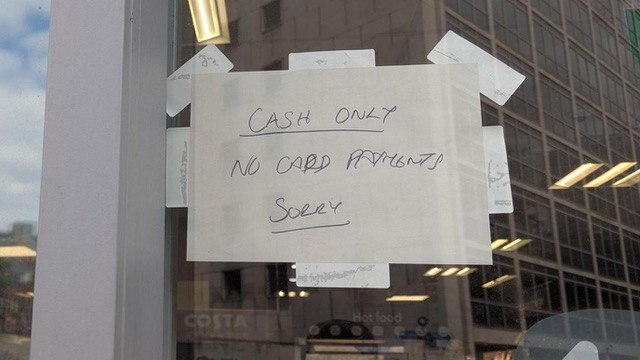
You don’t have any cash. You have your card though! Where’s the nearest cash machine?
You wander, somewhat aimlessly, trying to find a cash machine. You get your phone out to Google it. No signal.
You eventually find a NatWest, with a cash machine outside it. You go up to it and the screen’s off. Cash machines need electricity too. Of course they do. Fuck.
No money. You keep walking. You cross the bridge and look over the horizon. All the lights are off, as far as you can see. What the fuck has happened for it to be this bad? This is bad.
You overhear someone say it’s a Russian cyberattack (10). You don’t really know what to do about that.
On your way, you pass Guy’s and St. Thomas’s Hospital. They look like they’ve still got lights on and there’s a crowd gathering outside. There’s a police cordon between the crowd and the hospital, directing people towards Lambeth Palace. The Church are giving out hot drinks, bottles of water and apparently there’s a radio playing on the hour, every hour. Someone says they’re trying to conserve the battery. You get in the queue for a tea and hear Big Ben chime 11am. You listen into the radio (11).
BBC Radio 4 at eleven o’clock. The UK is currently experiencing a National Power Outage.
Stay inside as much as possible. Only leave your home if you have to.
The following is a public health message from the UK Chief Medical Officers - please listen carefully.
Hello, this is Professor Chris Whitty, Chief Medical Officer for England. I am about to provide you with important information. You may want to write this down so that you can refer to it later. We will be repeating this advice on BBC Radio 4 on the hour, every hour.
We have planned in case this extraordinary situation happened and this advice has been created by doctors and scientists to help keep you and your family healthy.
This advice for everyone will help you to plan how to use the food you have over the next few days. We are providing this advice on the basis that the power might be out for a number of days:
- take stock of how much food you have available for everyone in your household for the next few days
- prioritise what food you will eat first
- do not eat food that is rotting - throw it away immediately in an outside bin. Open the fridge and freezer doors as little as possible to keep them cold.
You are advised to wear several thin layers of clothing and wrap up warm. While you are sitting, keep your feet raised because air near the floor is colder. Get up and move around and stretch at least every hour. Get everyone in the house to gather in one room to share warmth. Put something like a towel or sheet under the doors of the rooms you are using to reduce draughts. Close your curtains and blinds when it gets dark to help keep the heat in. Use blankets or sheets to cover your windows if you don’t have curtains or blinds. Close the windows and doors in rooms you are not using.
We encourage you to look out for your neighbours, friends and family members who may be struggling at this time. We will provide more information and advice in the coming days.
The next broadcast will be at 12 o’clock.
Suddenly, it all feels very surreal. It’s a bit like Covid all over again. Your mind is racing with everything Chris Whitty has just said. You think they said it was Chris Whitty, he was the scientist on the telly during Covid wasn’t he?
Go home, look at what food you have, stay warm. You get your tea, pick up a bottle of water and start heading home.
The rain is starting to turn to snow. Stay indoors they said.
On your way, you see a long queue at a red phone box. People seem to actually be making calls (12). You don’t have any change so you keep walking. Even if you did, it’s getting quite cold now. You pick up the pace.
Eventually you get home. It’s a longer walk back from the office than you thought, and the snow made it freezing and quite slippery.
Your flat feels colder than usual. Normally the central heating would be on, but without the boiler, no central heating. You remember the advice about many thin layers, and so you pull another t-shirt on. You’d love a hot drink.
Despite having barely drank anything all day, you need the toilet. You flush when you’re done, and a driplet of water comes out. You try again. Nothing.
You go to wash your hands. Nothing comes out of the tap (13). I swear it was working in the morning.
You try the kitchen sink and get a few more drops, and then that dries up too. You go back to the bathroom, put the toilet seat down and close the door behind you. That’s going to get stinky if this holds out for much longer.
A few days they said on the radio. Really? That long?
You go to your fridge to take stock of the food you have. There’s some cheese, milk and half a pepper. You were meant to go to the shops after work. You’ve got some beans in the cupboard. You settle for a dinner of beans and a nibble of cheese for the night.
You’re still hungry.
You go across to your bookshelf. Nothing else to do I guess.
You move your sofa closer to the window so you can get more light and get reading.
As the sun starts to go down, it gets dark again. You light your one candle and keep reading, but once the sun sets, reading by candlelight turns out not to be as easy as the films always make it look, so you put your book away.
You’ve barely eaten all day, so you let yourself have another nibble of cheese in the dark. You finish the cheese and wash it down with some milk. Should probably finish that in the morning.
It’s getting pretty dark now. There’s still no lights on outside, and your flat is freezing.
It’s only 6pm, but you go and get into bed. At least it’s warmer under your duvet. You plug your phone in, just in case. It’s nearly dead anyway.
There’s not really much else to do, so you pull the blanket up close and try to fall asleep. Hopefully the power will be back soon. Surely…
Afterword
This is a fairly extreme example, but one that I think shows just how reliant on electricity we are, and how unprepared most of us are for a power cut.
I said it in note (3), but a malicious AI agent being employed by a hostile state actor to turn Britain’s lights off isn’t impossible, it’s not the vector through which we’re mostly likely to lose power for a few days. In all likelihood, it’ll be something much more boring like a voltage surge or a series of bad weather events happening at the same time. And whilst it might be highly unlikely, it would have a pretty monumental impact on our lives, and so it’s worth being prepared.
The character in our story wasn’t very prepared. They didn’t have any water or long-lasting food in the house, nor a torch/anything for light once it got dark, beyond one solitary candle. Candles are great, but they are also a fire hazard - a lady died in Madrid after her candle started a fire during the Iberian power cut. They also didn’t have any cash, which could have got them a drink when they were out - assuming the shops kept enough change…
Community groups like churches are likely to become critical lifelines for people in a scenario like this, and will need all the support they can get. Unfortunately, the longer the power stays out for, the more likely we are to see isolated pockets of public disorder and rioting on the streets. After all, it’s often said that Britain is only ever somewhere between four and nine meals away from anarchy.
Our character got a warm drink and listened to the radio at the church. They didn’t have their own battery powered/wind-up FM radio, which meant they couldn’t get any information beyond that. It’s a big vulnerability that most of us don’t fully appreciate.
FM radio continues to be one of the most resilient forms of communication we have. Even in a cyber attack and power outage that theoretically took everything else down, the BBC keep huge generators with up to 40,000 litres of diesel at radio transmission towers to be able to broadcast for at least three days straight. It’s also a critical part of the nuclear defence architecture, with British nuclear submarines allegedly checking to see if the Today programme on BBC Radio 4 is still broadcasting as an assessment for whether the UK has been hit by a nuclear strike.
As an example of how vulnerable other systems are, I considered whether the government would send out an Emergency Alert. But those alerts rely on mobile networks and you have to send it out before the reserve batteries on the masts die. Some masts don’t have batteries in the first place. In the end, I figured that the odds of enough of the right people scrambling in the dead of the night and getting an alert with useful information on it, fast enough that the masts can still deliver it, was probably unlikely.
But that’s not to say there aren’t redundancies - for example, key individuals have satellite phones that they can use to communicate, and there are recovery plans with common assembly points for key responders in the event of not being able to communicate at all. The government are also working on satellite technology that could provide up to a week of emergency phone and internet connectivity. One example of this that’s already in operation is HITS, which I’ve linked more information about in note (5).
And the power stays off for the whole day in our scenario. That’s not impossible. NESO plan to be able to get some parts of the network back on the same day, but they target 60% back within 2 days and the whole country back within 7. The Tom Scott video I linked in note (2) covers that process in more detail.
This is all to say that it’s not that much effort to Be Ready for something like this happening. Follow the advice, make sure you’ve got enough food and drink to last you three days and get a torch and a radio.
You can do better than our character.
RH
Notes from the Scenario
(1) NESO is the organisation responsible for the UK’s energy system and making sure that everyone gets electricity. They control the network, and when things go wrong, decide who loses power first and then, if it comes to it, how to restart the system.
(2) Tom Scott did a great video from inside the NESO control room a few weeks ago that explains how it all works much better than I have, which you can see here: https://youtu.be/NBXu6Z9Fw_M?is=2zKC0HBfdYgTZ_Br
(3) It should be said that this is an “exciting” example of a cyber attack actively directed by hostile state actors, but is by no means the only or even most likely vector for a power outage. The more likely scenario is something “boring” like extreme weather causing power lines to come down and floods that take out substations. It’s less ”exciting” but arguably more important a risk.
(4) This attack is a real hypothetical that could have a serious impact but hasn’t ever actually happened. You can read the original Princeton paper here: https://www.princeton.edu/~pmittal/publications/saleh-tnse19.pdf
(5) HITS stands for High Integrity Telecommunications System and you can read more about that here: https://assets.publishing.service.gov.uk/media/5a79ac7d40f0b642860d9e0d/hits_informationpack_v1.1_0.pdf
That note is 16 years old. I would be surprised if that was the extent of our backup systems. If I tried to cover the government response fully, I fear this would become a book and so I hope you forgive the sparseness of the details here. Maybe for another day…
(6) Mobile phone masts typically have batteries to keep them online for a little bit in the event of a mains power failure. Those batteries typically last up to four hours. In Lancaster and Spain, mobile phone coverage was lost within an hour and two hours respectively.
(7) Gas boilers have electric pumps. When the power goes out, that pump can’t run and so the gas boiler turns off. It needs electricity to power up again. And so, no hot water.
(8) Diesel buses can still run without power. 25% of London buses are diesel, and another 40% are hybrids, that could still run. You lose the c.35% that are battery electric if they didn’t get to charge overnight. This does assume that all of the bus drivers can and do show up for duty.
(9) Petrol stations rely on electric pumps to bring the petrol up from the tanks under the petrol station. No electricity, no functioning pump and no petrol. Some forecourts might have generators, but it’ll be the exception rather than the rule.
(10) In the Iberian power cut, false rumours started circulating pretty quickly that it was a Russian cyberattack.
(11) This is fictionalised, but based on the actual scripts written by the UK Chief Medical Officers for broadcast in the event of a National Power Outage. You can read them all here: https://www.gov.uk/government/publications/public-health-advice-from-uk-cmos-during-a-national-power-outage
(12) Most phone boxes won’t work. But there are some, very few, traditional phone boxes that have copper wires that can still make phone calls without power. But, you’d need the other person to also have a phone with a copper wire for them to be able to pick up - and Openreach are phasing out copper wire by 31 Jan 2027.
(13) Standard plumbing in the UK only runs at enough water pressure to get water up to the second floor of a building. If you live any higher than that, your water pressure is maintained by an electrical booster pump. Once the electricity goes out for long enough and the residual pressure in the system is used up, no more water.
Other Reading:
Lancaster Case Study, Royal Academy of Engineering - https://raeng.org.uk/media/xrrigg0m/raeng-living-without-electricity.pdf
Lancaster Case Study, The Blackout Report - https://www.theblackoutreport.co.uk/2019/12/11/lancaster-floods-living-without-electricity/
The Blackout Report - https://www.theblackoutreport.co.uk
London Power Supply Disruption Framework - https://www.london.gov.uk/sites/default/files/london_power_supply_disruption_framework_v4.0_-_public_version_0.pdf
The BBC article that beat me to the jump yesterday - https://www.bbc.co.uk/news/articles/ck5ynnj05z8no