I’ve long held the view that we, as a British society, will be in an existential battle for the survival of our way of life by the end of the decade.
I now think that the opening salvos of that battle are being launched as we speak, and that we are currently in a state of hybrid warfare.
I would love to write this without sounding too alarmist, but by the very nature of the topic, this will be a fairly bleak note.
I think it’s important to remember throughout that things are never as bad as they could be, nor are they ever as good as they could be. More often than not, things revert to the average, and so there needs to be a pretty high bar to let yourself think that things are going to be particularly good or bad for a prolonged period of time.
Based on what I’m seeing around the world, I think that bar is increasingly being met and that we’re entering a world where things are going to be particularly bad for a prolonged period of time.
The rest of this note explains why, and I welcome rigorous challenge and disagreement.
PRELOGUE
“By the end of the decade” is a best-guess. I don’t have a crystal ball, but I think we’re closer to this than we expect, and I think things are accelerating very, very quickly. When you consider that along with the ages of some of the world’s most powerful people (Trump is 80, Putin is 74, Xi is 73) and the current state of the world, I don’t think that some form of major escalation as I describe below in the next three years is unlikely.
So: “existential battle for the survival of our way of life”. What does that actually mean?
I think it means hostile states, like Russia, China and Iran, embarking on organised and sustained campaigns to try and disrupt daily life in Britain.
Activity that meets that definition sits along a spectrum. On one end, we have things that are annoying but not the end of the world. For example, DDoS attacks on council websites (i.e., flooding them with so much traffic that they can’t handle) that then take the website down for an afternoon. No one is going to die and you can recover quickly, but it’s disruptive if you wanted to pay your council tax that day, for example.
As we move along that spectrum, you get attacks on organisations that have a much larger impact when they go down. For example, attacks on the NHS that take computers down and delay treatment, which can in the most extreme scenarios cause patient deaths. Or attacks on critical national infrastructure that take down a power plant and mean vulnerable people can’t get heating in the middle of winter and die.
We’re already seeing all of the above take place in Britain by various states (which I cover in more detail below), but this is what the build-up to war looks like in the 21st century. Hostile states try and weaken their opponents until such a time they take more “real-world” actions. That could look like attacks on UK military bases or causing “accidents” in things like our national gas pipelines that cause explosions and kill people.
Eventually, it reaches a tipping point where you’re already at war and seeing large-scale troop deployments to defend the country. Perhaps that comes as part of a wider European response because Russia has invaded Estonia, or perhaps it comes as a direct conflict as a conclusion of these increasingly escalatory steps.
I think we’re on that escalatory ladder right now, and I really struggle to see how the powers that be de-escalate effectively to step off the ladder.
Let me explain.
GEOPOLITICAL LANDSCAPE
The world is increasingly an unstable place, and I think this sets the baseline for everything else I’m going to talk about today.
The war in Iran has left the Iranian state more aggrieved and inclined to undermine Western countries in response to the actions of the US and Israel in this conflict.
The Iranian government sees Britain as the “Little Satan” (the US is the “Great Satan”), because of historical reasons but also because of our facilitation of this conflict. RAF bombers haven’t been dropping bombs on Iran, but the US bombers that have have almost always come via this island. We’ve imposed sanctions on the regime and have been key players in trying to limit their development of nuclear weapons.
That makes the likelihood of retaliation by the Iranians higher than before this conflict began. We’re already seeing extensive evidence of this across Britain: Iranian-backed attackers took down a UK power plant earlier this year; Iran-backed attacks on Jewish communities across Britain throughout this year; Iranian and Romanian (who the Iranian govt have a track record of using to carry out attacks on dissidents in London) individuals allegedly trying to enter our nuclear base at Faslane - although I should note they weren’t prosecuted; and, I won’t comment on the recent incident at RAF Fairford as it’s an active investigation.
It’s difficult to say if the war is escalating or not. Right now, it’s highly likely that the US is holding off on further escalations ahead of the mid-terms on 3 November. But murmurings from the Pentagon suggest that the US military may be preparing to restart major combat operations after the election. Another aircraft carrier strike group left San Diego last week and means that the US will soon have three aircraft carriers and two amphibious landing groups in the Middle East, although one is expected to carry on to Japan shortly afterwards.
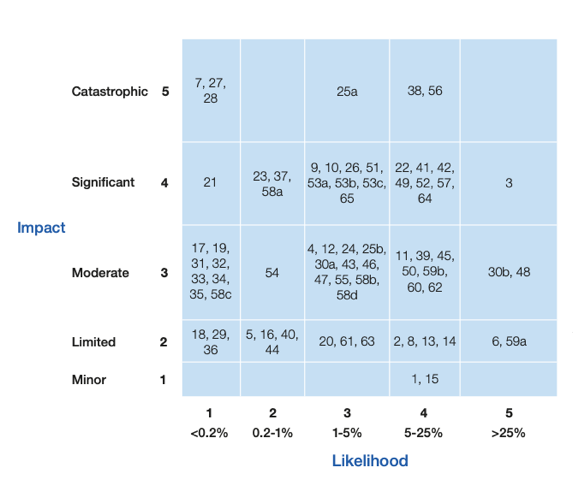
For Iran, this uncertainty isn’t unwelcome - the longer they can drag this conflict out, the better they think it makes them look. And increasingly, they’re escalating and trying to cause damage to the US and its allies around the world in response. One real-world example is the cyber attacks on water systems across at least 12 US states, which have largely been attributed to Iran-backed hackers. It is at this point that I would highlight that “water infrastructure failure or loss of drinking water” is one of the highest impact/likelihood events on the UK National Risk Register, in the same box as Pandemic (38 and 56 respectively, on the graphic below).
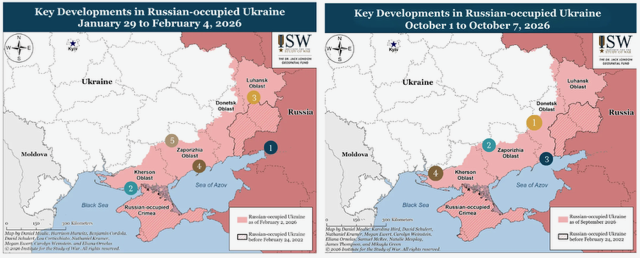
Next, let’s look at Russia. The conflict in Ukraine isn’t going very well for Vlad. They’ve taken land since the invasion, yes, but as the maps below show, they’ve actually lost territory to the Ukrainians over 2026 so far, despite an offensive over the spring and summer.
This has been a war redefined by drones and aerial warfare, and the Russians are increasingly using highly velocity missiles and bombs to attack Ukrainian cities as well as their critical infrastructure as we get closer to winter. The Russian war effort has benefitted from higher oil prices and will benefit further from the lifting of US sanctions on Russian diesel exports last night, allowing them to further ramp up attacks on Ukraine. But, the Ukrainians are also increasingly taking the fight to Russia, with attacks on retailer warehouses, oil refineries and energy sites, and AI and data hubs, causing real pain and disrupting life in Russia.
The Russian government has historically taken an outsized dislike to the UK. There’s a lot of history there, and at the best of times, they see us as their second biggest opponent. However, we are certainly not in the best of times, and since the war in Ukraine began, the UK has largely been portrayed by the Kremlin as public enemy number one, given both the strength of our support for Ukraine versus that of the US and the relatively warm relations between Presidents Trump and Putin.
And so, as the Ukrainians use British military support to increase the amount of pain that Russia feels, that puts an outsized target on our backs. I don’t for a moment think that means we shouldn’t be supporting Ukraine - after all, this is exactly the kind of thing that it is worth standing up for, even if it puts a target on your back - but it does put us at an increased risk of Russian-state-backed action to disrupt our lives.
We already know that Russia can act on our shores: by bribing UK politicians, like the former leader of Reform in Wales; setting fire to warehouses supporting the war effort in Ukraine; and trying to kill former spies, like Skripal and Litvinenko, on our shores. They’re involved in interference and trying to influence the UK by sowing distrust and exacerbating divisions to undermine confidence in our democracy. This is happening now; see the Rycroft Report and this Parliamentary debate in February if you want to learn more.
The longer the conflict in Ukraine goes on, and the more pain is caused to Russia, the more they’re going to try to undermine Britain and our way of life.
And to round out the geopolitical picture, let’s talk about China and the Chinese Communist Party (CCP) specifically. There’s obviously a clear difference between Russia and Iran in one camp, who are actively in conflicts with countries that we support, and China, who isn’t. But China does actively support both the Iranian and Russian war efforts against the US and Ukraine respectively. All of these efforts have fallen short of sending troops (which infamously, North Korea has been doing in Ukraine to little success), but China is supporting both countries with supplies and intelligence to help them strike allied assets.
Re Ukraine, China has a deep strategic partnership with Russia. It provides equipment that is used by Russia to build the drones and missiles that land on Ukrainian cities. There are lots of (admittedly unconfirmed) reports that Chinese military observers are on the Russian frontline, learning from the latest innovations in battle and taking that back to help produce more advanced technology to give the Russians the upper hand. They’re also working together to try and take down Starlink, which is the primary form of communications for the Ukrainian military.
In Iran, China was allegedly behind the geospatial intelligence that allowed Iran to successfully target the US Airbase in Jordan in June. There’s also evidence that Chinese supplies have continued to funnel into the country, helping them to rebuild missiles and weapons for future attacks. Critically, this seems to have included shipments of sodium perchlorate, which is used to create missile rocket fuel. In addition to physical support, China has been an economic lifeline for both countries. It’s Iran’s largest trading partner, the primary buyer of Iranian oil, and provides both countries with a way around Western sanctions.
This is consistent with a wider posture shift from the Chinese government towards taking strategic positions that undermine the US-led world order and increase their own influence. It expands further within their “sphere of influence”, largely in the South China Sea, where China claims a sweeping disputed territory, as shown in the graphic below.
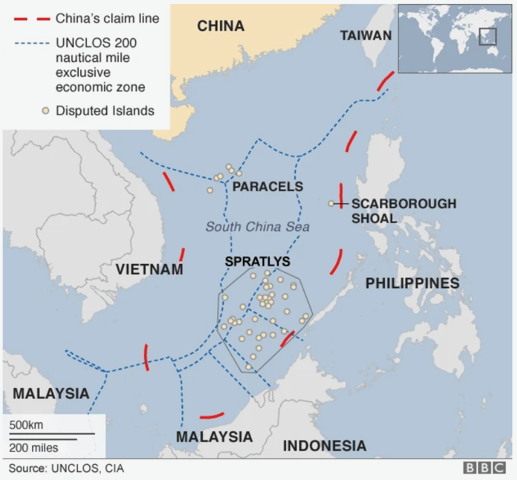
These claims aren’t new, but were rejected by a 2016 tribunal at the Permanent Court of Arbitration in The Hague under the rules of the United Nations Convention on the Law of the Sea. China disputes the case and continues to posture militarily in the region, particularly around Scarborough Shoal, which is claimed by China, Taiwan, and the Philippines. So far this year, there have been increased tensions, with the Chinese military obstructing Philippine ships and conducting military drones around the Shoal.
This military posturing also extends to Taiwan, where China has a stated objective to “re-unify” by 2049 and has increasingly been carrying out grey-zone attacks in and around Taiwan aimed at normalising Chinese presence. In June, Chinese Coast Guard vessels broadcast messages saying that “Taiwan’s future lies in national reunification”. They regularly see coastguard ships, flights, and civilian drones enter their territory without permission, and the Taiwanese suspect that Chinese vessels have also been severing undersea communications cables in and around the territory.
This kind of grey-zone attack isn’t isolated to their own sphere of influence though, and this is where the threat to the UK really catalyses itself. UK National Security Advisers have assessed that Chinese state-backed actors are the largest threat to UK economic security: China dominates our supply of critical minerals that go into our manufacturing (like cars but also defence equipment) and isn’t afraid to use that vulnerability as a weapon; Chinese companies also increasingly try to control critical strategic assets, like British Steel (nationalised by the Government to stop the last virgin steel foundry in Britain closing, as proposed by their former Chinese owners), communications networks (famously, banning Huawei equipment from the 5G network) and wind turbine factories in the Highlands.
We increasingly see the CCP pursue dissidents in the UK, gathering information about people they see as their opponents, including running covert police stations at sites across Britain, which were closed after a police investigation (that did find no evidence of criminal activity). Chinese state-affiliated actors conducted cyber attacks on the Electoral Commission in 2021 and on China-sceptic MPs, the former of which compromised the names and addresses of tens of millions of UK voters. Only last week, the Security Service released an Espionage Alert that an organisation linked to the Chinese Ministry of State was funding academic research in the UK to improve their ability to spy. The same week, the UK and international partners warned of a China-linked company enabling cyber actors to target organisations in the UK and allied countries.
With the widespread prevalence of Chinese technology in our homes, they have unprecedented ways to collect data and spy on the country at large and exploit our Internet of Things devices to launch large-scale cyber attacks. Chinese electric vehicles are also becoming very popular on our roads. This is entirely speculative and there’s limited evidence to support it at this stage, but I would be incredibly surprised if the CCP didn’t retain some ability to immobilise those vehicles, if they so wished, to cause widespread disruption on our roads.
As time goes on and our conflicts with China’s allies in Russia and Iran continue to escalate, the incentives for China to undermine and disrupt our lives increase, and make it more likely that their interference also escalates.
And finally, a word on North Korea. North Korea isn’t on the same threat level for Britain as Iran, China, or Russia, but it would be irresponsible not to mention them at all.
North Korea sits on the same axis of authoritarianism as these countries and provides a lot of support to what they’re trying to achieve around the world. As I mentioned above, they’ve sent troops to Russia as well as missile launchers and munitions. They also have sizeable cyber capabilities - they were responsible for the WannaCry attacks that affected the NHS in 2017 and regularly steal billions of dollars of cryptocurrency to fund their weapons programmes - and weapons programmes (both ballistic and nuclear) that are increasingly advanced: US defence analysts now think that North Korean weapons are capable of launching nuclear attacks on the continental United States. That would obviously be a crazy thing for them to do, with very little upside, but there is a clear ideological purpose and as the world gets more unstable, it would be irresponsible to ignore the disruption they could cause.
NUCLEAR
Another factor that overlays across the whole geopolitical picture is nuclear, where the situation across the world is now the worst it has been since the end of the Cold War. The New START treaty between the US and Russia, that aimed to limit nuclear proliferation, expired in February. There are no signs that a new treaty is on the way.
That puts us in a world where, for the first time since 1991, the world’s largest nuclear powers aren’t treaty-bound to reduce their nuclear stockpiles. This comes just as both countries have been developing new and more sophisticated weapons, such as long-range hypersonic missiles, which are more manoeuvrable than ICBMs and therefore harder to shoot down. The Pentagon was also ordered to restart nuclear testing on par with Russia and China last year.
We’re also in a world where the threat of using nuclear weapons in live conflicts is a very real one. The Russians lowered their threshold for what would justify a nuclear strike in 2024. It was previously a conventional strike that would threaten the very existence of the state, and in 2024 they changed that to be a conventional attack that creates a critical threat to the sovereignty or territorial integrity of Russia or Belarus. As the war in Ukraine has evolved, some military analysts now think that losing parts of the territory that Russia has gained in Ukraine would classify as that critical threat and may justify a nuclear response from the Russians.
That nearly came to the fore in 2022 (before the formal change in doctrine, but possibly the reason it changed), as the Russians were increasingly losing ground in Kharkiv and Kherson. Russian state media began reporting that Ukraine was nearly ready to use a dirty bomb, and would set that off and blame Russia for launching a nuclear weapon. That was laying the ground for real plans to use a tactical nuclear weapon, which Russia could then put down to being a Ukrainian dirty bomb and claim to have said this would happen all along.
The other key 2024 revision to the Russian nuclear doctrine was to say that any aggression from a non-nuclear state (a la Ukraine) that was supported by a nuclear-armed state (a la the UK) would be treated as a joint, collective attack.
That means that when Ukraine, whom the UK supports, attacks Russia, Russia sees that as a joint attack by both Ukraine and the UK.
This is why, earlier this year, when the UK and France gave Ukraine access to blueprints that will allow them to build more complex missiles, Russia responded by saying that UK drone factories may face attacks from unknown sources. After NATO exercises around the Russian exclave of Kaliningrad earlier this year, from which it should be said Russia launches regular hybrid warfare tactics against Baltic and Western European countries, Putin sent NATO a letter saying that Russia would be prepared to use its entire arsenal, including nuclear weapons, to defend itself.
These are unwelcome escalations, and whilst a lot of it may just be political posturing, it goes without saying that should any of these conflicts around the world turn nuclear, that would be catastrophic for everyone. But the longer the war in Ukraine goes on, the more pain it causes Russia, the more likely a nuclear misstep becomes.
SPACE
The space threat is one that we don’t talk about very often and is largely an untested weapon in the hybrid war, at least in the fullest sense of its capabilities.
Space is critical for the continuation of our way of life as we currently enjoy it. Our lives are underpinned by constellations of satellites above our skies and if they went down for 24 hours, it would cost the UK £1.4bn. One of the most important functions these satellites perform is synchronising timing across global systems, such as those in finance (i.e., how you pay for things in the shops), telecoms (i.e., everything you need mobile signal or the internet for) and transport (i.e., cars, trains, planes and ships all having no idea where they are), where it’s critical that everyone involved is working on the exact same time. It’s underpinned by the American GPS, which is effectively the default system for much of the world, but there are also European, Russian and Chinese equivalents. Here in Britain, we largely rely on the American and European systems.
And these are all reliant on satellites that sit about 12,000 miles above the Earth, so by the time their signals make it to us, they’re quite weak, very easy to drown out, and easy to imitate. And that’s happening around the world, notably around the wars in Ukraine and the Middle East. These are, in theory, intended to block the signals to wireless drones, missiles, and guided weapons. In practice, they also impact commercial flights and daily life for people trying to use navigation or ride-sharing apps, because their devices can’t work out where they are.
And so if you wanted to cause widespread disruption to life in the UK, jamming our satellites and making sure the signals either don’t come through or come through wrong would be a very effective way of doing so. That’s led to a bit of an arms race in space, with the US, Russia, and China all developing increasingly advanced space weapons (the US Space Force released quite an interesting piece outlining how the Space Warfighting Environment could look in 2040 - it’s a good read if you want to know more).
For the UK, there’s already evidence that hostile states are taking advantage of this to cause disruptions to our way of life. Last year, the head of UK Space Command warned that Russia had been trying to jam UK satellites every week; in June, a Russian satellite constellation caused GPS disruption across Europe and Canada, and the RAF warned of more and more irresponsible and provocative actions from our adversaries. In response, the UK’s Space Effects Squadron has increasingly been jamming other nations’ satellites to defend the UK.
SOCIAL DIVISION
Hostile states have an incentive to undermine our democracies and disrupt the rule of law in our societies. They increasingly do this by enhancing social division in our country to, in my opinion, garner support for political movements at the edges of societal acceptability. The more they can divide our society, the more they can cause people to take to the streets, often violently, and the more political support they can get for political parties that are pro-hostile nation and rival the traditional political movements that take a strong stance against the hostile state.
There’s not just one way that hostile states do this, but the main two that I can see are weaponised migration and social media manipulation.
Russia’s Africa Corps (formerly Wagner Group) has caused widespread insecurity across the Sahel and North Africa, displacing millions of refugees and putting more pressure on people smuggling routes into Southern Europe and the EU. In Northern Europe, Russia has moved people from the Middle East and Africa and effectively pushed them over the border into Finland and the Baltics. This exploits existing divisions in these countries around migration and gives credence to those political extremes.
Equally, Iran’s state broadcaster created fake accounts on Facebook and Twitter to push pro-independence narratives in the 2016 Scottish independence referendum, and the Russian interference in the US elections via social media is well covered. As we increasingly see more and more extreme views seep into the public consciousness, I would posit that it’s likely that there’s significant hostile, foreign interference on the social media networks we, as a society, spend so much time on, seeking to stoke up division.
Of course, you can’t talk about social media manipulation without talking about Elon Musk, who I think does the exact same thing to further his own political aims. There is also a wider conversation about the undue influence large billionaires like Musk have on our security and way of life, not least given his personal control over SpaceX (critical for launching US military satellites), Starlink (critical for Ukrainian military communications), and X (arguably the most influential social media platform in the world). But for today, it comes back to the social division that his actions cause, and the weakened position that puts the UK in.
This all comes back to giving power to political movements at the edges of societal acceptability. If these actors succeed at sowing social division, they also give more political power to those edge movements, like Reform here in the UK, which in turn causes a flywheel effect and furthers social division. Hostile states clearly benefit when these parties do well, and will increasingly try to create the conditions within which they can succeed by exacerbating our problems.
Now these problems exist already, but by amplifying them, hostile states are trying to trigger social unrest and give power to groups within the country that are willing to take to the streets to protest, often violently, their government - which conveniently also takes a strong stance against the hostile state on the international stage. That distracts the government and means they spend their time fixing domestic problems that have bubbled to the fore, rather than focussing on hostile states and foreign threats. The more people take to the streets, the more your ordinary way of life is disrupted. And the more political power these edge movements get, the weaker the democratic values that underpin our way of life become.
ACCELERANTS: AI + WEAK FINANCIAL MARKETS
AI is the great accelerant to all of the above. The fundamental advantage that AI gives you is that it makes everything faster, and it’s improving on an exponential basis itself. In this context, fast is bad and increases the likelihood of a miscalculation.
We’ve already seen the negative consequences of AI involvement in military systems with the US bombing of the school in Iran, triggered by a reliance on an AI technology that identified targets and had limited human oversight. As we move to a world where AI is increasingly used in military systems, there will be more frequent incidents where lots of things were being done by an AI system, which somewhat overwhelmed human reviewers and ultimately led to a catastrophe. The more military accidents we see, the greater the risk of a miscalculation somewhere along the journey that erupts into something undesirable.
AI also makes it infinitely easier for hostile actors to map out the vulnerabilities in our critical national infrastructure, create exploits that take advantage of them, and then deploy en masse. That’s a level of attack we’ve never had to defend against before and will uniquely test our defences. As I mentioned earlier, defence only has to fail once for it to catastrophically disrupt your life, and I don’t think this problem is being taken seriously enough by organisations in the UK. I think that’s all going to culminate in an AI catastrophe in the next nine months - it may not be hostile-state backed, but the risk from misaligned AI thinking it’s doing something beneficial but actually causing real damage is incredibly high right now, and I fear it will take a catastrophe to make people take it seriously.
The other accelerant that interacts across all of the above is financial markets.
Global markets are currently building out the infrastructure behind the AI revolution. Whenever new consumer technologies that are as revolutionary as AI come to the market, there’s an initial mania in markets where everyone races to build out the infrastructure that will underpin the technology and capture a piece of the pie. In doing so, they build far too much supply than demand can keep up with, and the market comes to a fantastic halt and everything crashes. The golden age then follows where the companies that really capture the value of the new technology are built and go on to succeed. But before you get there, you have a crash, and I think we’re increasingly getting closer and closer to one. Now the million-dollar question is when it will come - and there’s a lot of money to be made between now and then - but I have little doubt that it will come.
Consider alongside that the record levels of financial leverage currently in the system (i.e., how much people have borrowed to be able to do what they’re doing), and any upcoming crash will test the financial stability of organisations across the financial system. I suspect a lot of organisations will be caught with their trousers down and we’ll see a lot of defaults and companies going under, exacerbating and prolonging any crisis.
Historically, financial crises lead to social unrest and division as people who have lost out look for someone to blame. More often than not, it’s scenarios like that that see extreme political ideologies come to the fore, by blaming the financial crisis on “that other group, over there”. I’m sure those hostile-states that look to undermine us will be trying to exploit those divisions as much as they can.
When you layer both of these factors across everything above, I think they potentially accelerate everything else I’ve talked about, whichI think is a very scary prospect for the rest of the decade.
AND EVERYTHING ELSE
There’s a few other topics that I’ve covered elsewhere and haven’t gone into great detail about here, but I think are worthy of a quick mention.
The first is the expansion of hybrid warfare across Europe, which I covered in further detail here.
The second is the Arctic battlefield, which is increasingly becoming another factor to consider across all of the above, especially as Russia and China increasingly support trade routes through the North Sea. I talked about this alongside the vulnerabilities of our undersea communications cables in an earlier piece as well.
CONCLUSION
That’s my rationale. I think the UK is currently in the middle of a hybrid war against these hostile states, and that this is an early stage of an escalatory ladder that is putting us on track for an existential battle for the survival of our way of life by the end of the decade.
We’re not currently adequately prepared for what’s coming. Britain is currently not resilient enough to protect ourselves against these threats. The Government knows this and seems to be working at double speed to change that, but a big part of national resilience is individuals taking responsibility and making sure they’re as prepared as they can be.
And so, if you read this note and agree with my conclusions, it may be sensible to think through what you might do in these scenarios and if you have the appropriate preparations in place. See https://prepare.campaign.gov.uk/get-prepared-for-emergencies/ for more details.
And if you don’t agree with my conclusions, please hit reply and tell me why. I would very much welcome challenge and criticism.
RH
Not financial advice.