A lot is going on across Europe right now. I think that’s left us in a highly elevated yet largely underappreciated risk position.
For what it’s worth, I do think that these are largely macro developments that are unlikely to directly impact your life in the immediate term. But if these dynamics continue to evolve along the way we’re currently seeing, I think there’s a realistic probability that these might have serious impacts on our lives in the medium term.
Let’s go on a tour of Europe.
- Poland and the Baltics
War no longer starts when the tanks roll over the border; they start with a hybrid campaign that weakens your infrastructure and sets the basis for a future invasion. Poland and the Baltics have been the victims of attacks like this, as Ukraine was, for many decades, but there’s been enough of a notable step change here recently that I think Poland and the Baltics are increasingly beginning to look like the second front line in the war against Russia.
Poland saw an attack on their energy infrastructure over winter that echoed a similar attack on Ukraine in 2015, and had it been successful, would have left half a million Poles without heating in the middle of winter. Just last month, a Russian cruise missile entered Polish airspace and landed in a field over 100km inland. Some have suggested that it was meant to hit Ukraine and veered off course, but the distance it travelled and the way it landed suggest that it was targeted.
In November 2025, two Belarusians blew up a railway in Poland that was being used to send aid to Ukraine. I think this is a great example of the kinds of hybrid warfare we’re now going to experience. That act of blowing up the railway would probably be considered a terrorist attack. You can make assumptions that it was backed by the Belarusian state. Given how close Belarus and Russia are (I effectively think of Belarus as an extension of the Russian state at this point), you could assume that it was conducted under the orders of the Russian state. And if it’s a state-backed terror attack on your infrastructure, how do you respond? Can you respond strongly after having made that series of assumptions, or do you need more concrete proof - which probably isn’t going to be conclusive either way? And how do you respond? Is that an act of war? Where do you draw the line?
And this isn’t the only example; we’re seeing more and more things like this - Russian drones entering NATO airspace in Poland and scrambling aircraft which then shoot them down (Christmas 2025); ditto Romania (last week), Finland, Latvia, Estonia, and Lithuania this year to name a few. They’ve also been weaponising migration to sow division and destabilise these countries, by digging tunnels under the border and sending migrants over the border. That causes political unrest and provides a wonderful landscape for pro-Russian (often far-right) parties to take advantage and say you should vote for them rather than the anti-Russian parties because they’ll kick all the migrants out. I wouldn’t be surprised if Africa Corps (previously Wagner Group) are doing similar with African migrants into Southern European countries.
I think the biggest risk is the Baltic states at the minute, because they have Russian-speaking minorities that Russia could (and is trying to) claim they’re liberating (à la the Anschluss of Austria in 1938). Russia has been recruiting locals to effectively create a support system for any little green men, just as they did in the Donbas ahead of the 2014 invasion of Crimea.
I’m particularly worried about Narva in Estonia. It’s a small town right on the border with Russia and has a non-zero Russian-speaking population. It’s not unfeasible to me that Russia tries to take this little town and then just waits. Estonia is a NATO country and would be entirely within its rights to trigger Article 5. Europe would be in support of it, but would the Americans? Is President Trump going to commit American lives to defend Narva? I’m not convinced, and I think Putin would love to test that. If it works, NATO falls apart, and suddenly we’re in a very different world and the European security landscape is in a much more dangerous place.
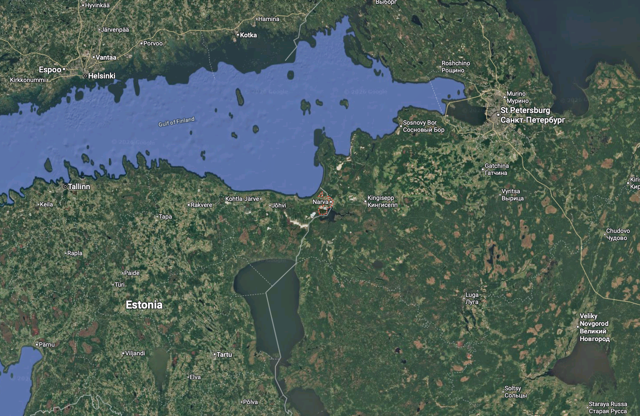
There’s a UK-led NATO Rapid Response Force in Estonia, exactly for this kind of thing. If they have to go and defend Narva, does that put the UK (and whatever is left of NATO) at war with Russia?
It sounds bonkers and it’s probably not imminent, but we’re getting closer and closer to it becoming a reality. The Polish PM thinks that Russia will be ready to confront Europe in 2027.
Let’s check in on the rest of the continent.
- Germany
Germany is the industrial heartland of Europe. The tanks and air defence systems being used on the Ukrainian front line are made in Germany. It’s also a critical hub for pan-European military logistics because it has Ramstein Air Base, which is the US Air Force’s European headquarters. Any operations in the European, Middle Eastern or African theatres of war are orchestrated from Ramstein - I can’t stress how critical it is to basically any NATO military operation on this side of the Atlantic.
Increasingly, we’re seeing drones show up at German airports. To date, this was mostly just annoying - drones would show up at airports like Munich and air traffic control would close the airport for a bit. In recent months, they’ve been spotted flying over sensitive sites, such as Ramstein.
And then last week, a drone was found at Leipzig airport by a cargo plane taking military equipment to Ukraine. This drone had a tin packed with Semtex attached to it. Another drone was then found, without any explosives on it, and a week later, a third drone was found with more explosives on it.
As I mentioned at the top of this note, war no longer starts when tanks roll across the border. 100 years ago, tanks and aircraft were the revolutionary, war-changing technology of the time. In 2026, I’d argue that drones are the war-changing technology of our time. And so, if explosive drones fly over the border into Germany, do you call that war? If it was a tank, you would.
Now I should say that it hasn’t been officially confirmed that this was a Russian drone. US intelligence suggests that the drones belong to Russian intelligence services. President Tusk hasn’t come out and said as much, but some German government officials have directly accused the Russians of being behind this attack.
It’s the first attack on military supply lines in NATO territory being used to power the war in Ukraine.
- Britain
Which brings us back to home shores. Britain is a big supporter of Ukraine and has been since the war began. Last week, the Prime Minister announced that we (alongside the French) would be giving Ukraine the blueprints to make the British components needed for long-range, French Storm Shadow-esque cruise missiles. Now there’s a whole other debate about using highly technical missiles like this and how realistic it is that that would be sustainable in a protracted conflict, but that’s a conversation for another time - Google Project Brakestop if you are interested in the interim.
The key point about these missiles is that they enable the Ukrainians to conduct offensive strikes deep into Russian territory. Now they are doing that to an extent already - there have been large-scale drone attacks on Moscow and St. Petersburg already in an attempt to increase the economic and political cost of the war directly onto the Russian population. Cruise missiles raise that cost exponentially.
Now it’s safe to say that the Russians see the UK as their greatest geopolitical rival after the US. There’s a lot of history there and they would really like to respond to our support for Ukraine, which we know they can and have done in the past - see both Litvinenko and Skripal.
They have also been making worrying manoeuvres with respect to the underwater cables that connect us to the rest of the world, which I’ve written about in the past, but are now threatening a direct attack. There has been some coverage about attacks on UK military bases by third parties and/or attacks on factories being used to make drones - the likes of which were used to attack oil refineries earlier this year.
Now strong words with respect to Britain from Russia isn’t necessarily a new story, but when considered in the wider context of what we’re seeing across Europe - recognising that there are UK troops in Germany and Estonia - it’s a bit more worrying than it otherwise would be.
- US
Amidst all of the above, the US made a pretty interesting move this week - the Director of the CIA, John Ratcliffe, flew to Moscow on Tuesday, for what’s widely being considered a meeting to tell the Russians that “we know what you’re about to do and would very strongly recommend that you don’t do that.”
The last time a CIA Director flew to Moscow to deliver a similar message was four months before the invasion of Ukraine.
That makes for a very compelling narrative here, but it would be misleading to leave it there. Reports suggest that the main point of the visit was to give the Russians a frank assessment of how their war in Ukraine was going and how they were unlikely to win, alongside a warning against the hybrid warfare we’ve seen across Europe.
It’s a bad time for the risk of any European kinetic activity that the US would have to get involved in. Weapon stockpiles are allegedly largely depleted following the war in Iran, and these highly technical missiles and weapons take years to build and top up strategic reserves and stockpiles. In a world where your opponent is sending cheap but deadly drones your way, maybe that type of weapon system is no longer how you should be arming your troops.
This comes at the same time as the US Defence Secretary Pete Hegseth has been kicking out a number of senior Generals and Army officials. This has stalled efforts to develop plans to fight wars with drones, and rid the Army of battle-hardened officials in what is effectively a time of war for the US.
Coupled with a large concentration of US military assets in the Middle East around Iran, and the prospect of having to get more involved in a European conflict doesn’t look particularly compelling.
If you’re Russia and want to break NATO, maybe that’s a button you choose to press.
- Everywhere else
And finally, war no longer exists in a vacuum. There are increasingly two axes that are on opposing sides of global conflicts, and it’s increasingly difficult to see one conflict in isolation from another. Russia has been supporting Iran throughout the war and has been using Iranian drones in Ukraine in return. Ukraine has attacked Iranian vessels in the Caspian Sea in recent weeks. China has military observers alongside Russian troops on the frontline, watching and learning lessons from the most advanced conflict the world has ever seen. North Korea has been supplying arms and personnel to the Russians.
It’s all very interconnected, and the spillover effects are worrying. It would be difficult to stop things climbing the escalation ladder if and when things start getting hotter.
RH