I promised a few weeks ago to write on recent events in Mali. As ever, I’m going to start by giving you the context, and then talking about what happened recently. I’ll refrain from making commentary on what might happen next, for reasons that will become clear.
THE CONTEXT
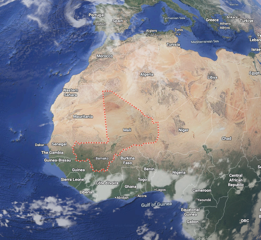
Mali is huge. Much of the population live in the South of the country (particularly in the green parts of the map below) and along the River Niger which you can also just about make out on our map. The bulk of the landmass covers the Sahara Desert, which historically gave Mali an advantageous position from which to control trans-Saharan trade and gave rise to a series of powerful and wealthy empires (c.1300), including that of Mansa Musa, one of the richest people in history.
During the Scramble for Africa in the 1800s, the French colonised Mali and made it part of French Sudan. The Republic of Mali then gained independence in 1960. The imposition of these borders were problematic for certain ethnic groups, including the Tuareg people whose historic territory spread across Mali, Burkina Faso, Niger, Algeria and Libya. And so, since independence, the Tuareg and the Malian government have regularly been in armed conflict as the Tuareg rebel.
The current conflict has been ongoing since 2012 (yes, 14 years - it’s not a typo). That conflict started after the President was ousted in a military coup, and a Tuareg rebel group, in cahoots with al-Qaeda, took control of Azawad, a region of northern Mali, which includes Timbuktu. They declared independence (which, of course, no one accepted), but then the two groups fell out and began fighting each other. The rebels lost, and al-Qaeda took control of most of the Azawad region, with the Malian government inviting the French military to help win back control. That military operation eventually morphed into Operation Barkhane, a wide-reaching multi-national counter-insurgency operation across the Sahel.
Various peace deals were signed in the decade that followed, none long-lasting. There were allegations of election fraud in 2020, which led to another military coup and the deposition of Malian President Keita in 2020. The military junta then took control of the country in 2021 and invited the Wagner Group (now Russia’s Africa Corps) to begin operations in Mali and support the fight against the Tuareg rebels. This led to the end of Operation Barkhane, and reports of random beatings, killings and the torture of civilians by Africa Corps mercenaries.
WHAT HAPPENED RECENTLY
On the 25th of April, the Tuareg rebels joined forces with al-Qaeda militants and launched a large-scale offensive across Mali, taking control of two cities, Kidal in the north and Mopti in the centre. At the same time, car bombs went off and sustained gunfire was heard in the capital and across the country. Kidal is an interesting battleground in this conflict, with the Africa Corps only taking control off the rebels in 2023. Now, it seems that they reached an embarrassing deal with the rebels that allowed them to leave, and the rebels have since offered to “build a balanced and effective future relationship” with the Africa Corps if they withdraw from Mali.
This was the largest, most coordinated attack by the rebels in years, and is a scary indicator on the resurgence of terrorism across the Sahel, where 51% of global terrorism related deaths occurred in 2024. It followed a months-long fuel blockage in Central Mali, and it seems the rebels are trying to trigger a coup similar to that seen in Syria when Ahmed al-Sharaa’s rebels overthrew the Asaad regime. (And as an aside, NPR did a great piece on how the persecuted Uyghurs were a key part of the Syria rebels offensive - https://www.npr.org/2026/05/17/g-s1-113270/uyghurs-china-syria-war-fighters-rebels-bashar-al-assad).
WHY IT’S SO DIFFICULT TO SAY WHAT MIGHT HAPPEN NEXT
There’s a huge gap in reporting on the situation in Mali. Some publications do try, but it’s hard to find reliable fine details as budget cuts hit foreign correspondents desks around the world. And so, it’s really hard to understand the live situation, and whether the junta and the rebels will move closer to negotiation or escalation.
Sadly, what is clear is that the Sahel remains the global hotspot for terrorism. That has a two-fold effect as the death and devastation across the Sahel spills across to other countries in the region. That fuels mass displacement within these countries and pushes migrants north into the Maghreb and Southern Europe. Anecdotally, in Carlo Masala’s “If Russia Wins: A Scenario”, migrants from Mali were forced into Europe to fuel far-right sentiment and drive division within our communities.
All in all though, it’s a pretty dreadful situation that isn’t getting the international attention it deserves, and so I hope if nothing else, it spurs you to read beyond the headline the next time you get a BBC News notification on Mali.
RH